
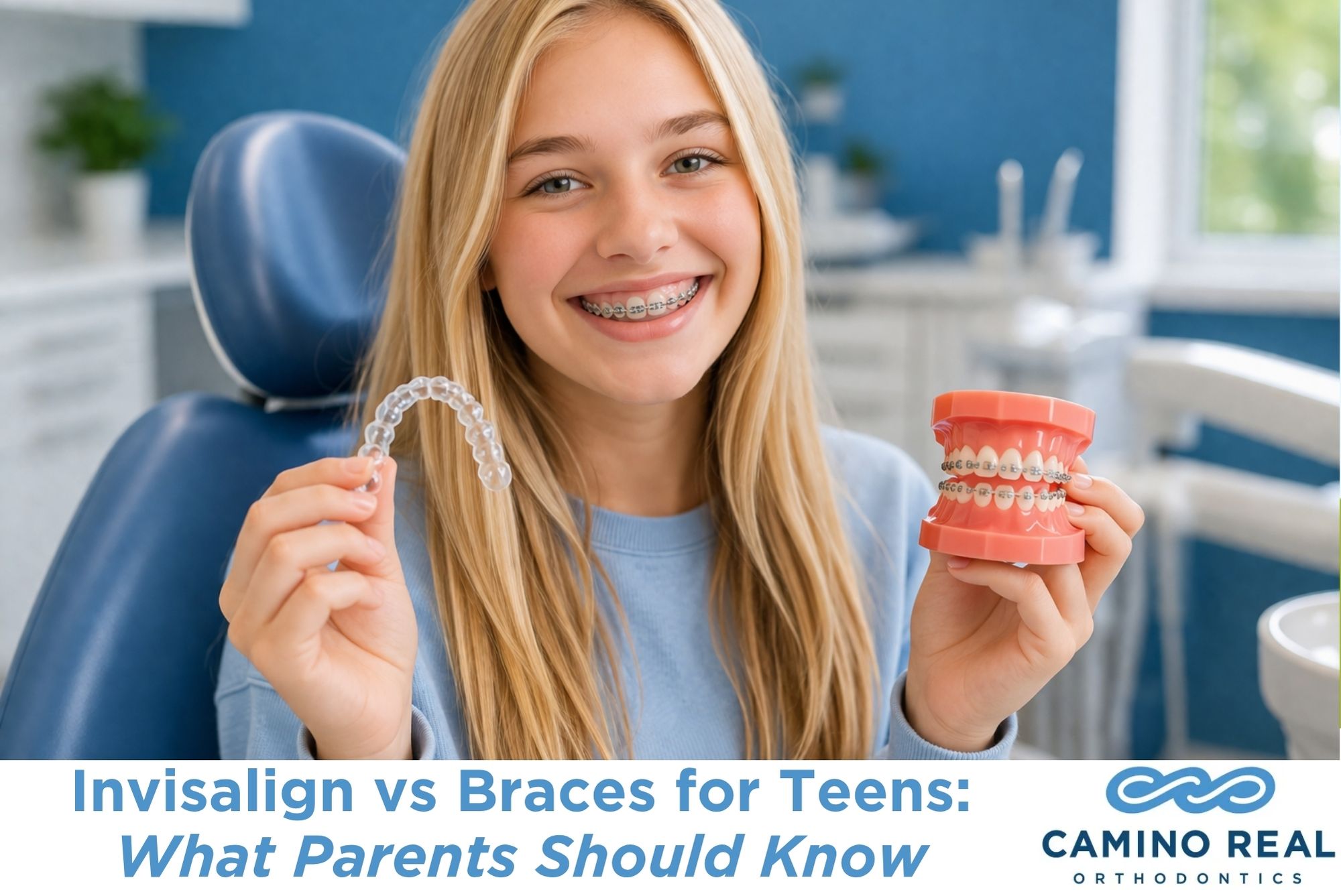
Choosing the right orthodontic treatment for your teen is an important decision that can impact their confidence, oral health, and long-term well-being. With advancements in orthodontics, parents today often weigh two primary options: traditional braces and Invisalign clear aligners.
At Camino Real Orthodontics, we understand that every teen—and every smile—is unique. This guide will help you compare Invisalign vs. braces so you can make an informed decision for your child.
Why Orthodontic Treatment Matters for Teens
The teenage years are an ideal time for orthodontic treatment because the jaw is still developing, making it easier to correct alignment issues. Proper orthodontic care can:
- Improve bite function and chewing efficiency
- Prevent future dental problems
- Boost self-confidence during critical social years
- Enhance long-term oral health
What Are Traditional Braces?
Traditional braces use metal or ceramic brackets attached to the teeth, connected by wires that are adjusted over time to move teeth into proper alignment.
Benefits of Braces
- Effective for complex cases (severe crowding, bite issues)
- No need to remember to wear them—they’re fixed in place
- Typically more cost-effective
- Modern options are smaller and more comfortable than ever
Considerations
- Visible on teeth (though ceramic options are less noticeable)
- Dietary restrictions (avoid sticky or hard foods)
- Requires careful brushing and flossing
What Is Invisalign?
Invisalign uses a series of custom-made, clear aligners that gradually shift teeth into place. Teens receive multiple aligners and switch them every 1–2 weeks.
Benefits of Invisalign for Teens
- Nearly invisible appearance
- Removable for eating, brushing, and special occasions
- No food restrictions
- More comfortable—no wires or brackets
Considerations
- Requires discipline (must wear 20–22 hours per day)
- Can be lost or forgotten
- Not ideal for all complex orthodontic issues
Invisalign vs Braces: Key Differences
| Feature | Invisalign | Braces |
| Appearance | Clear, nearly invisible | Visible (metal or ceramic) |
| Removability | Yes | No |
| Comfort | Smooth plastic | May cause irritation initially |
| Maintenance | Easy brushing & flossing | Requires special tools |
| Effectiveness | Best for mild–moderate cases | Works for all cases |
| Compliance | Must be worn consistently | No compliance required |
Which Option Is Better for Your Teen?
The best choice depends on your teen’s lifestyle, responsibility level, and orthodontic needs.
Invisalign May Be Ideal If Your Teen:
- Is responsible and will wear aligners consistently
- Plays sports or musical instruments
- Is concerned about appearance
- Has mild to moderate alignment issues
Braces May Be Better If Your Teen:
- Needs treatment for complex dental issues
- Might forget or lose aligners
- Prefers a “set it and forget it” solution
- Wants a potentially more budget-friendly option
How Camino Real Orthodontics Helps You Decide
At Camino Real Orthodontics, we take a personalized approach. During your teen’s consultation, we evaluate:
- Bite alignment and jaw development
- Tooth spacing and crowding
- Lifestyle and habits
- Treatment goals
We then recommend the most effective and efficient solution tailored specifically to your teen.
Q&A: Invisalign vs Braces for Teens
Q: Is Invisalign as effective as braces for teens?
A: Invisalign is highly effective for mild to moderate cases. However, braces are typically better for complex orthodontic issues.
Q: How long does treatment take?
A: Both Invisalign and braces generally take 12–24 months, depending on the case.
Q: Is Invisalign more expensive than braces?
A: Costs are often comparable, though Invisalign may sometimes be slightly higher depending on treatment complexity.
Q: Will Invisalign affect my teen’s speech?
A: There may be a slight adjustment period, but most teens adapt quickly within a few days.
Q: Are braces painful?
A: Braces can cause mild discomfort after adjustments, but it usually subsides within a few days.
Q: Can my teen eat normally with Invisalign?
A: Yes! Invisalign aligners are removed during meals, so there are no food restrictions.
Q: What happens if my teen forgets to wear Invisalign?
A: Inconsistent wear can delay treatment progress and affect results. Compliance is key.
Q: How often are orthodontic visits needed?
A: Typically every 6–8 weeks for both Invisalign and braces.
Start Your Teen’s Smile Journey Today
Choosing between Invisalign and braces doesn’t have to be overwhelming. With expert guidance from Camino Real Orthodontics, you can feel confident you’re making the best decision for your teen’s smile and future.
Contact Information
Camino Real Orthodontics
📞 (760) 434-2288
Carlsbad Office
3144 El Camino Real, Suite 205
Carlsbad, CA 92008
La Costa Office
6994 El Camino Real, Suite 101
Carlsbad, CA 92009
🌐 Website: caminorealortho.com
📅 Request an Appointment →: